
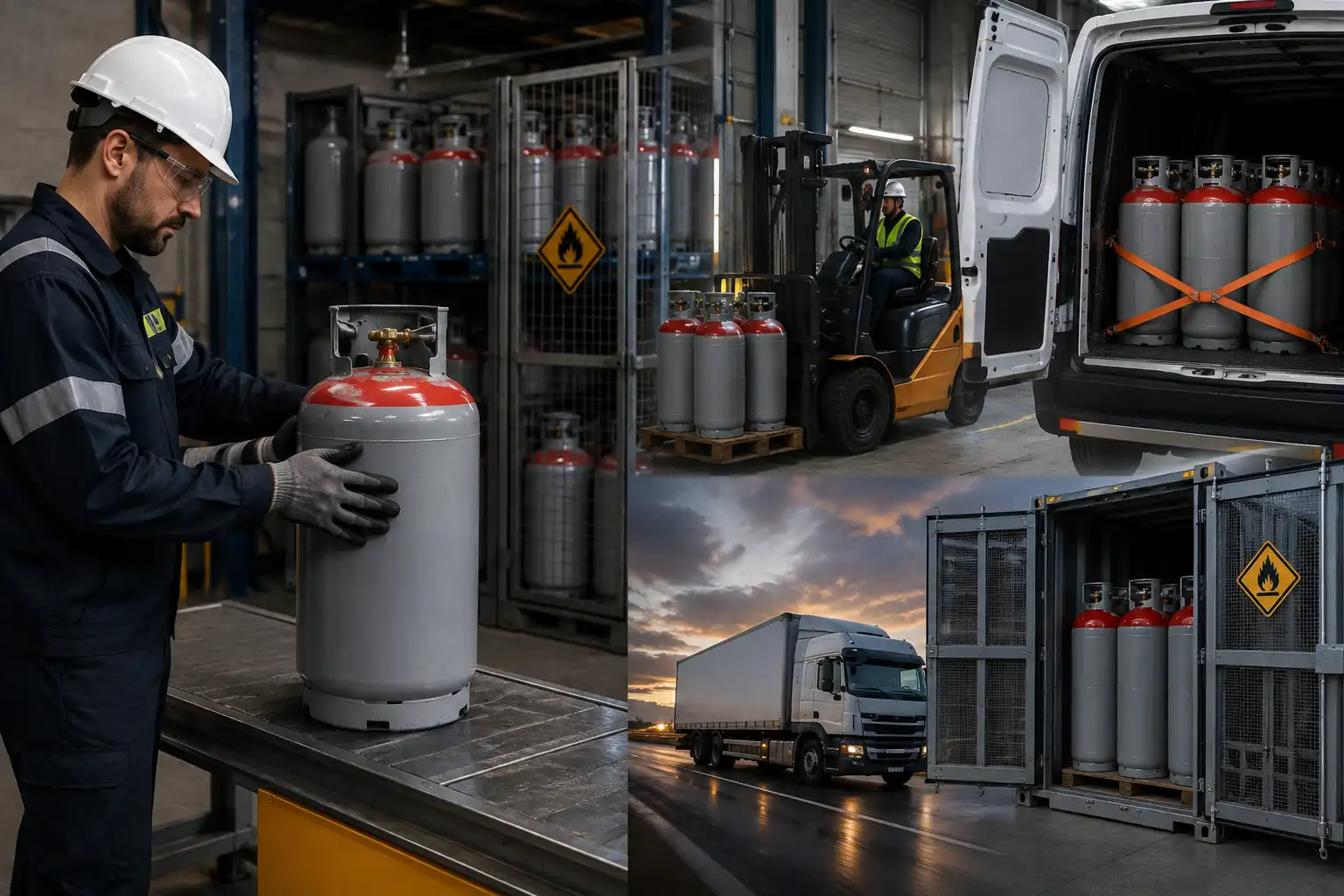
Quick answer: A2L refrigerants R-454B, R-32, R-1234yf, R-454A, R-454C, and R-452B are classified as “lower flammability” under ASHRAE Standard 34 and require specific handling under ASHRAE 15-2022/15.2-2022 and UL 60335-2-40. Systems under 4 lbs of charge need no leak detection or mitigation. Larger systems require integrated leak sensors, charge limits tied to room size, and in some jurisdictions, rigid line sets and shaft ventilation. For transport, up to 440 lbs can generally move without DOT placarding, but a Class B dry chemical fire extinguisher is required on the vehicle. EPA Section 608 certification still applies no separate federal license exists yet, though some states are adding requirements.
If you’re buying, storing, or servicing R-454B, R-32, or R-1234yf in 2026, this is the one regulatory area where “I’ll figure it out on the job” gets expensive either through a failed inspection, a voided warranty, or a code violation on a commercial install. Here’s what actually changed, what didn’t, and where the rules genuinely differ by state.
Why This Suddenly Matters (And Why It Didn’t Five Years Ago)
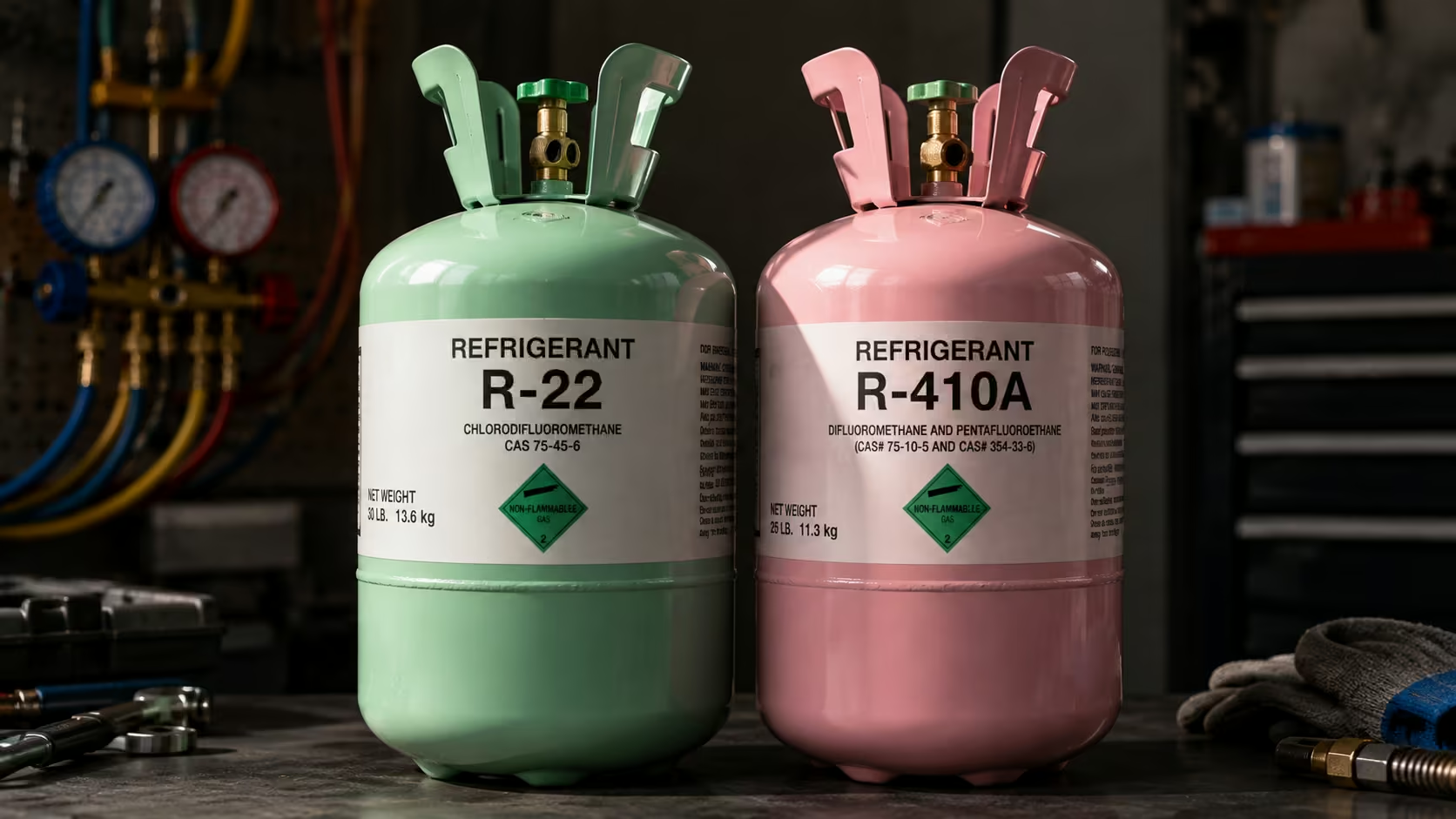
For over two decades, nearly every refrigerant a US HVAC contractor touched R-22, R-410A, R-404A was ASHRAE Class A1: non-toxic, non-flammable. There was no flammability protocol to learn because there was nothing to protect against.
That changed with the EPA’s AIM Act Technology Transitions Rule. The first deadline hit January 1, 2025, covering most new residential and light commercial split systems, packaged units, chillers, and small variable refrigerant flow (VRF) systems under 65,000 BTU/hr all now barred from using refrigerants with a GWP above 750. R-410A (GWP 2,088) doesn’t qualify. Its replacements R-454B (GWP 466) and R-32 (GWP 675) do. Both are A2L. A second deadline in January 2026 extended the same GWP cap to larger new and existing VRF systems, which is a much bigger design problem because VRF piping runs refrigerant through occupied space on every floor it serves.
The result: a refrigerant classification that used to be a footnote in ASHRAE Standard 34 is now the default for nearly every new residential AC and heat pump sold in the country. Handling it correctly isn’t optional expertise anymore it’s baseline.
What “A2L” Actually Means
ASHRAE Standard 34 classifies every refrigerant on two axes: toxicity (A = lower toxicity, B = higher) and flammability (1 = none, 2L = lower flammability, 2 = flammable, 3 = higher flammability). A2L sits between “won’t ignite” (A1, like R-410A) and “genuinely dangerous to store near ignition sources” (A3, like R-290/propane).
Two properties define the “2L”:
- Lower Flammability Limit (LFL): the minimum concentration of refrigerant in air needed to sustain ignition. R-32’s LFL is roughly 4x higher than propane’s — meaning it takes a much denser refrigerant-air mixture before ignition becomes possible at all.
- Burning velocity below 10 cm/second: the speed a flame front spreads if ignition does occur. A2L refrigerants burn slowly enough that, in most real-world leak scenarios, they self-extinguish before propagating.
ASHRAE 15 caps the allowable refrigerant concentration in occupied space at 25% of the LFL a substantial safety margin built directly into the code, not left to installer judgment.
A2L Refrigerants Currently in the US Market
| Refrigerant | Composition | GWP | Primary Use | Cylinder ID |
|---|---|---|---|---|
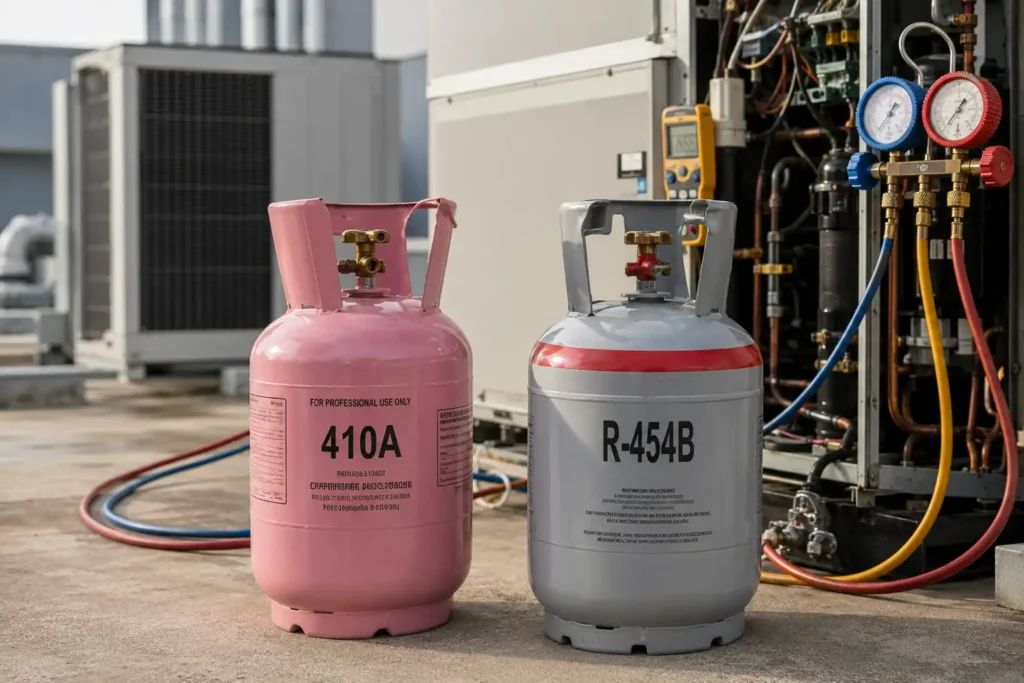
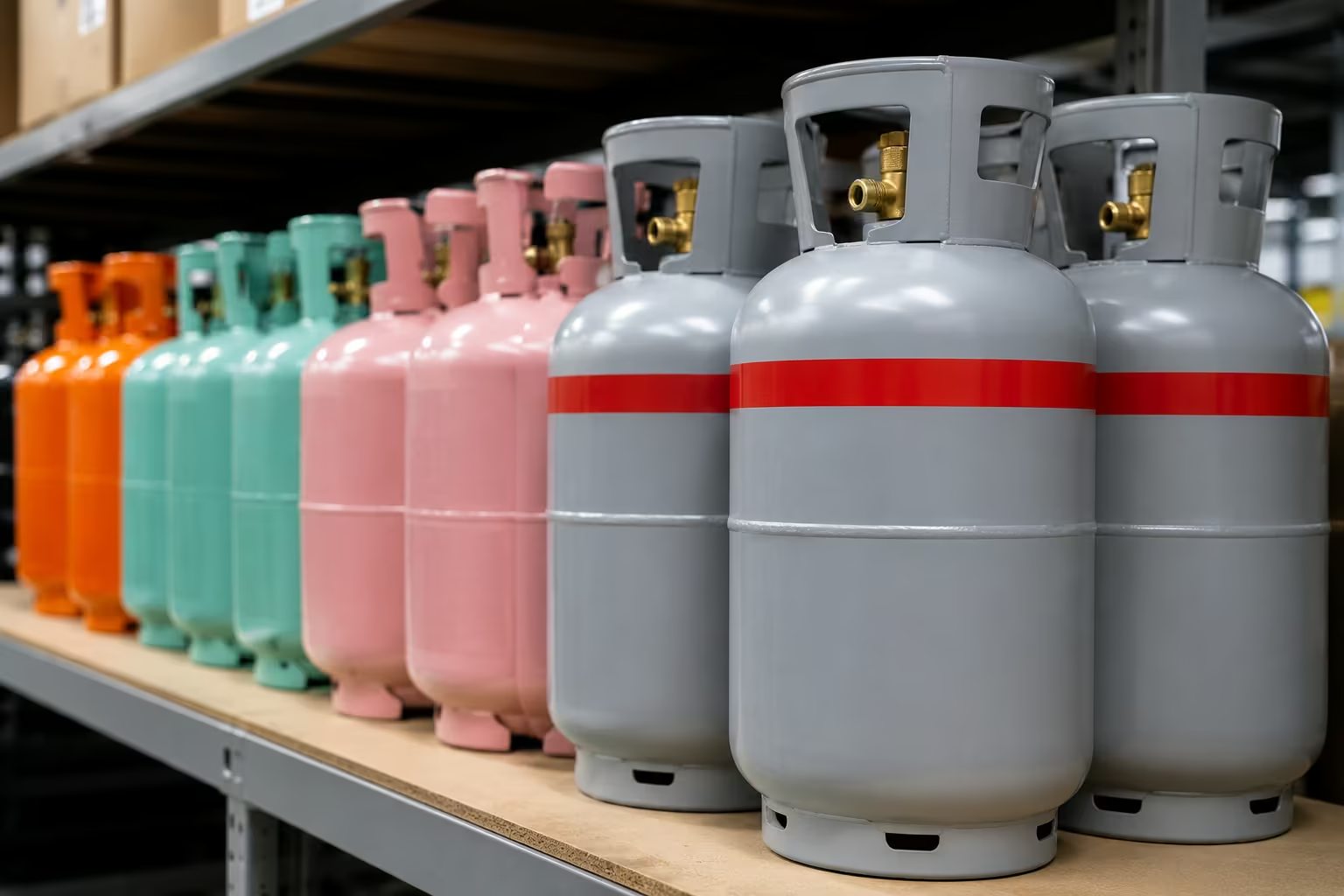
| R-454B | R-32/R-1234yf blend | 466 | New residential/light commercial HVAC | Red cylinder shoulder, left-hand thread valve |
| R-32 | Single component | 675 | Residential/light commercial HVAC (esp. mini-splits) | Manufacturer-specific, check SDS |
| R-1234yf | Single component | <1 | Automotive MVAC (2013+ vehicles) | Standard MVAC fitting, distinct from R-134a |
| R-454A | R-32/R-1234yf blend | ~238 | Commercial refrigeration retrofit | Manufacturer-specific |
| R-454C | R-32/R-1234yf blend | ~148 | Commercial refrigeration, lower-charge systems | Manufacturer-specific |
| R-452B | R-32/R-125/R-1234yf blend | ~698 | Commercial refrigeration, R-410A replacement | Manufacturer-specific |
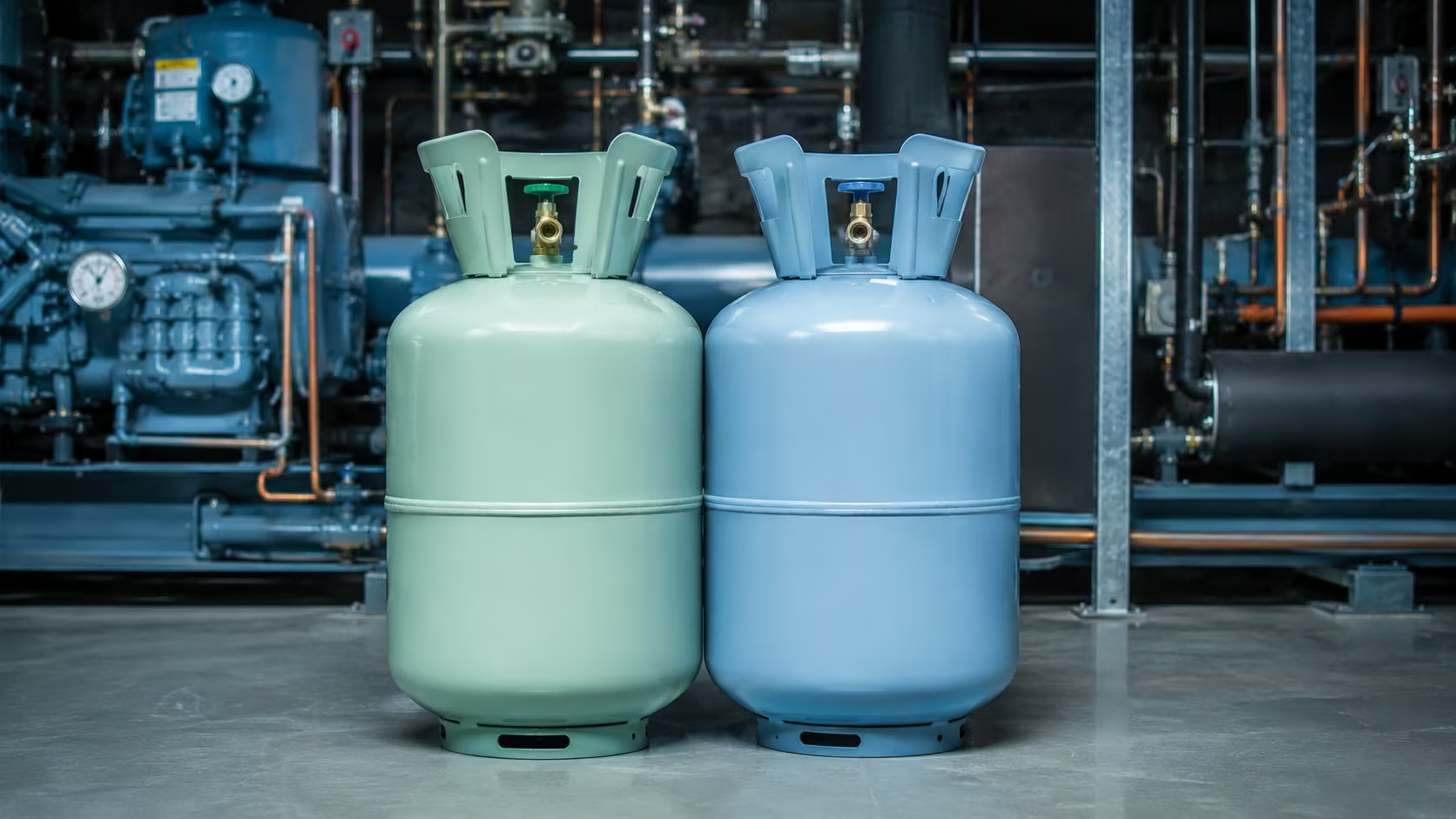
The left-hand thread valve on R-454B cylinders isn’t cosmetic it’s a cross-contamination safeguard so a standard R-410A fitting physically cannot connect to it by mistake. If you’re training junior techs, this is worth calling out explicitly; it’s a detail almost nobody mentions until someone’s stripped a fitting trying to force it.
Storage Requirements: Warehouse and Distributor Level
If you’re storing A2L cylinders in volume which applies to us as a wholesaler and to any distributor reading this, the core practical requirements are:
- Ignition source separation. Keep A2L cylinder storage away from open flame, welding/brazing operations, and electrical equipment not rated for the area’s classification. This is standard NFPA-aligned practice even though refrigerant-specific NFPA guidance is still evolving state by state.
- Ventilation. Because R-32 and R-454B are heavier than air, they collect at floor level in a leak. Storage areas should have low-point ventilation or monitoring, not just ceiling-level exhaust a detail that trips up warehouses designed around older, lighter-than-air refrigerant assumptions.
- SDS accessibility. Safety Data Sheets for every A2L product in inventory need to be physically accessible on-site, not just filed digitally somewhere no one checks during an OSHA walkthrough.
- Hazardous Material Inventory Statement. Facilities storing A2L refrigerant above certain thresholds may need to file this with the local fire authority thresholds vary by jurisdiction, so this is one to confirm with your local AHJ (Authority Having Jurisdiction) rather than assume.
- Segregation from A3 refrigerants. If you also stock R-290 (propane-based, A3), keep it physically separated from A2L stock different fire code thresholds apply, and mixing them in a single storage zone can push the whole area into a stricter classification.
None of this requires a specialized “flammable refrigerant warehouse” it requires deliberate zoning of what you already have.
Transport and DOT Requirements
This is the part most contractors underestimate because A2L transport, in practice, looks a lot like transporting R-410A with two specific differences:
- Fire extinguisher requirement. Vehicles carrying A2L refrigerant should carry a Class B dry chemical fire extinguisher appropriate for flammable gas/liquid fires, not the general-purpose extinguisher some service vans already carry for other reasons.
- Placarding threshold. Under DOT hazmat rules, quantities up to roughly 440 lbs of A2L refrigerant can generally be transported without triggering full DOT placard requirements on the vehicle. Above that threshold, standard Class 2.1 (flammable gas) placarding and driver hazmat endorsement requirements apply the same framework used for other flammable gas shipments, not a new regulatory category invented for refrigerants.
- Orientation. A2L cylinders can be transported horizontally or vertically unlike some other hazardous materials, there’s no vertical-only requirement driving special racking in the truck.
For most single-van HVAC contractors carrying a handful of cylinders to a job site, this rarely crosses the placarding threshold. For distributors and wholesalers moving pallet quantities, it does and that’s a driver-training and paperwork issue, not just a “can we ship it” one.
On-the-Job Handling: What Changes for Technicians
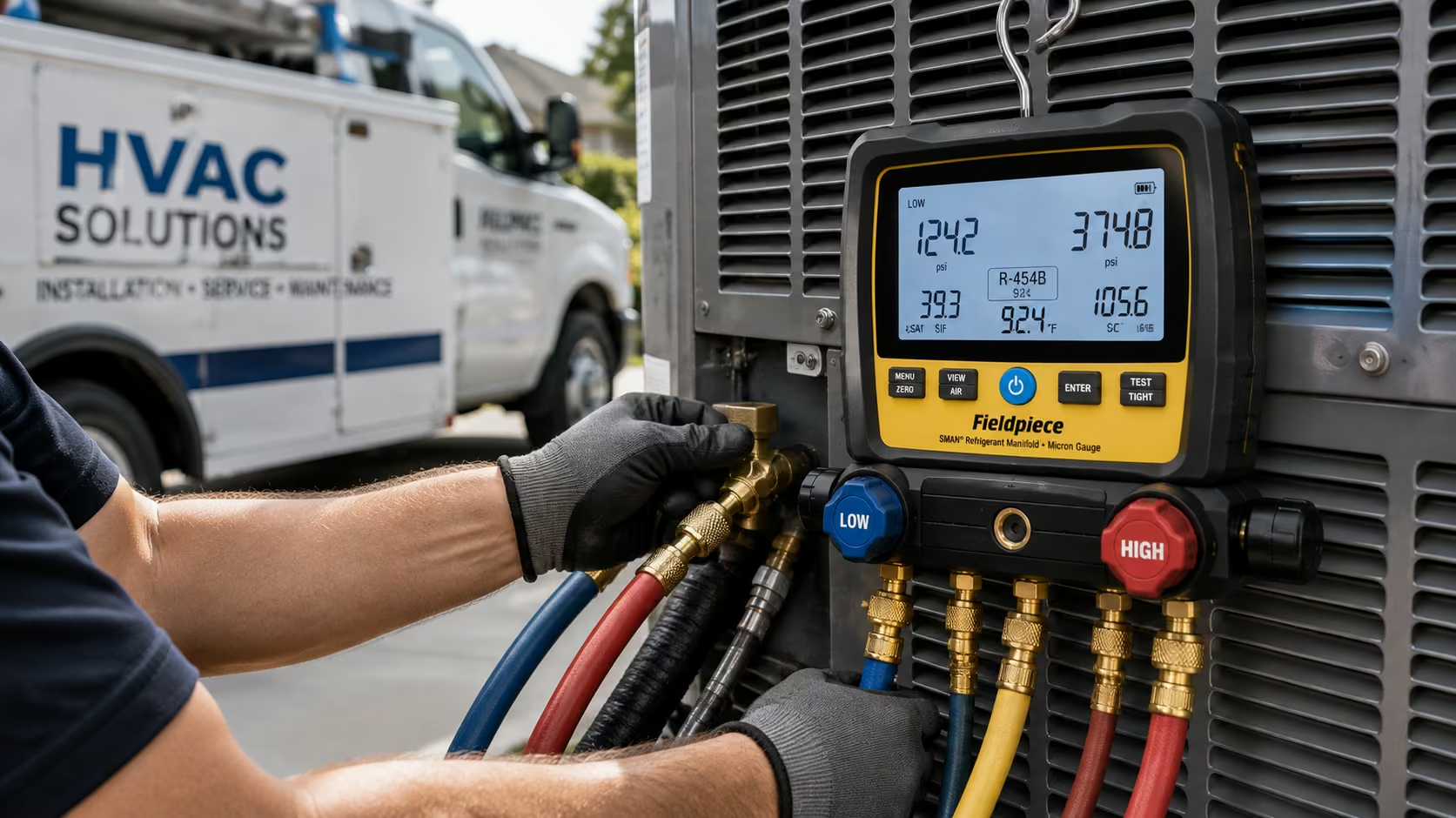
- Leak detection is now built into the equipment, not optional add-on. UL 60335-2-40 (4th edition) requires A2L indoor units connected to high-probability leak paths to carry an integrated leak detection sensor with a sensitivity of at least 5 grams/year. If you’re servicing one of these units, you’re not adding a sensor you’re diagnosing one that’s already there.
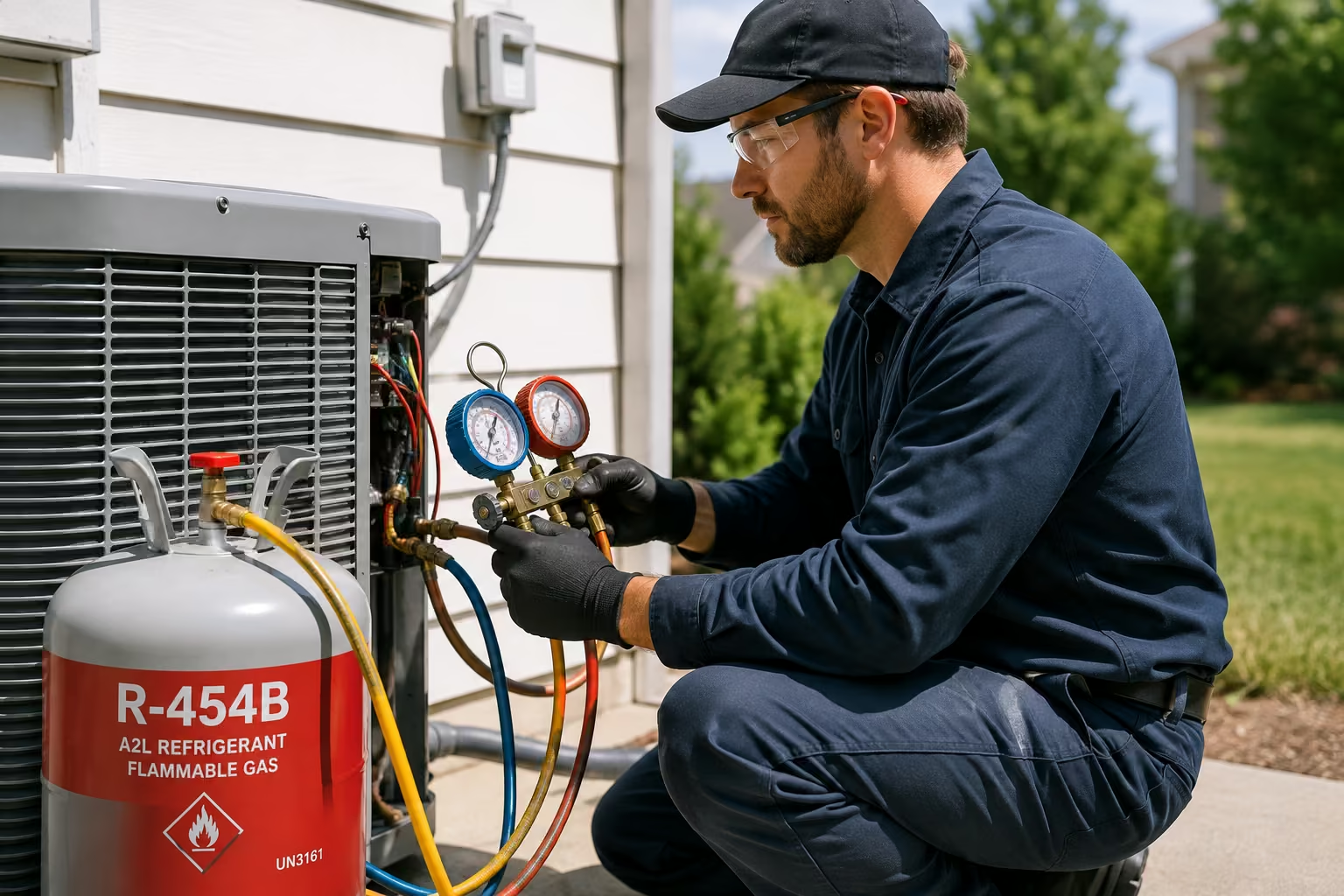
- Nitrogen purge during brazing is non-negotiable, more than it already was. Any open-flame brazing on an A2L line set without an active nitrogen purge risks both oxidation scale (the old reason) and, in a leak scenario, an ignition source sitting directly at the point of highest concentration (the new reason).
- Non-sparking tools in confined, poorly ventilated spaces. Not required on every job, but standard practice when working in mechanical closets, crawlspaces, or shafts where a leak could concentrate before dispersing.
- Recovery equipment must be A2L-rated. Standard recovery machines built for A1 refrigerants are not automatically rated for A2L service — check the equipment’s own classification before using it on R-454B or R-32.
- EPA Section 608 certification is still the operative federal credential. There is currently no separate federal A2L-specific certification requirement layered on top of 608 — but check your state, because some jurisdictions (Washington, California, and New York among them) have begun adding flammable-refrigerant-specific provisions through their mechanical codes rather than through EPA.
Building and Installation Code Requirements
This is where the real complexity lives, and where “check local code” isn’t a hedge it’s the honest answer.
The baseline standards are ASHRAE 15-2022 (commercial/general) and ASHRAE 15.2-2022 (residential), both of which govern how much A2L refrigerant charge is allowed in a given room, based on room volume, ventilation, and whether the system uses integral leak detection with automatic mitigation.
Under 4 lbs of charge, no detection or mitigation is required at all the standard treats that quantity as inherently safe regardless of room size. Above that threshold, allowable charge scales with room area using formulas in UL 60335-2-40’s Annex GG, which most manufacturers now publish as lookup tables rather than expecting installers to run the math manually.
Adoption is not uniform
The 2022 ASHRAE standards and the 2021/2024 International Mechanical and Fire Codes have incorporated A2L allowances, but individual states and cities adopt code editions on their own timeline and frequently add local amendments on top. A few examples that illustrate the range:
- California’s 2025 Mechanical Code requires compliance with both ASHRAE 15-2022 and 15.2-2022 for A2L systems in human-comfort applications, and requires re-approval of previously permitted plans if the specified refrigerant changes during construction.
- Seattle’s 2021 Mechanical Code (locally amended, effective November 2024) folds in ASHRAE 15-2022, 15.2-2022, and 34-2022 by reference.
- New York City has added building-specific requirements beyond the base ASHRAE standard refrigerant lines penetrating two or more floors require a fire-rated shaft enclosure, and soft/flexible line sets common with R-410A multi-splits are often disallowed in favor of rigid copper protected from puncture.
The practical takeaway for contractors: the equipment manufacturer’s installation manual will reflect UL 60335-2-40 compliance, but the building code requirements shaft ventilation, fire-rating, permitted line set type depend on what your local jurisdiction has adopted and amended. Pulling the permit is what surfaces this, not the equipment box.
A2L vs. A1 vs. A3: Handling Requirements at a Glance
| Requirement | A1 (R-410A, R-134a) | A2L (R-454B, R-32, R-1234yf) | A3 (R-290/propane) |
|---|---|---|---|
| Flammability | None | Mildly flammable, low burning velocity | Highly flammable |
| Leak detection required | No | Yes, above 4 lbs charge (equipment-integrated) | Yes, at much lower thresholds |
| Ignition source control | Standard shop practice | Nitrogen purge, non-sparking tools near leaks | Strict — hazardous area classification |
| DOT placard threshold | Higher / non-flammable gas class | ~440 lbs before placarding | Much lower thresholds |
| Charge limits by room | Not applicable | Yes, per ASHRAE 15/15.2 + UL 60335-2-40 | Yes, significantly more restrictive |
| Certification | EPA Section 608 | EPA Section 608 (some state additions) | EPA Section 608 + often state/local flammable-gas permits |
Common Compliance Mistakes We See
- Assuming EPA 608 alone covers everything. It covers refrigerant handling broadly, but it doesn’t override local mechanical or fire code requirements around A2L charge limits, line set type, or shaft ventilation.
- Reusing A1-rated recovery equipment on A2L systems without confirming the machine’s own classification a warranty and safety issue, not just a compliance one.
- Treating “under 4 lbs = no rules” as “under 4 lbs = no code review.” The charge exemption is real, but permitting authorities still expect documentation of what refrigerant and charge quantity are in the system.
- Storing A2L and A3 cylinders together without segregation, which can trigger a stricter fire code classification for the entire storage area than either refrigerant would require on its own.
Frequently Asked Questions
Is R-454B dangerous to work with?
R-454B is classified A2L — mildly flammable with a low burning velocity, meaning it’s difficult to ignite and tends to self-extinguish if it does ignite. It requires specific handling protocols (nitrogen purging, leak detection, non-sparking tools near concentrated leaks) but is not comparable in risk to A3 refrigerants like propane.
Do I need a special certification to handle A2L refrigerants?
EPA Section 608 certification remains the operative federal requirement for refrigerant handling, including A2L. There is no separate federal A2L certification as of 2026, though some states have begun layering additional requirements through mechanical and fire codes — check your state’s specific adoption.
How much A2L refrigerant can I transport without DOT placards?
Generally up to approximately 440 lbs before standard Class 2.1 flammable gas placarding and driver hazmat endorsement requirements apply. A Class B dry chemical fire extinguisher should be carried in the vehicle regardless of quantity.
Can I store R-32 and R-410A cylinders in the same warehouse area?
Yes R-32’s A2L classification doesn’t require full segregation from A1 refrigerants the way it does from A3 (propane-based) refrigerants. Standard ignition-source separation and ventilation practices still apply to the A2L stock specifically.
Why does R-454B need a different cylinder valve than R-410A?
R-454B ships with a left-hand thread valve specifically to prevent a technician from accidentally connecting standard R-410A service equipment to it a physical safeguard against cross-contamination, not a manufacturing variation.
Will R-410A systems need to be retrofitted to A2L refrigerants?
No. Existing R-410A equipment can continue to be serviced with R-410A (virgin or reclaimed) for the life of the system. The GWP restriction applies to new equipment manufactured after the relevant compliance date, not to servicing existing installed systems.
Where This Fits If You’re Buying or Distributing A2L Refrigerant
If you’re a contractor stocking up ahead of a job requiring R-454B or R-32, or a distributor building out A2L inventory, the storage and transport requirements above aren’t a reason to hesitate on the transition R-410A supply is on a shrinking quota through 2029 either way. They’re a reason to make sure your receiving area, your delivery vehicles, and your service trucks are set up correctly once the cylinders arrive.
Sources: ASHRAE Standard 15-2022 and 15.2-2022 (Safety Standard for Refrigeration Systems); ASHRAE Standard 34-2022 (Designation and Safety Classification of Refrigerants); UL 60335-2-40, 4th Edition (2022); U.S. EPA AIM Act Technology Transitions Rule; U.S. DOT Hazardous Materials Regulations, 49 CFR Division 2.1; California 2025 Mechanical Code; Seattle/Washington State 2021 Mechanical Code; NYC HPD A2L Guidance memo (2025).
Specific charge limits, room-area formulas, and local code amendments vary by jurisdiction and refrigerant blend. This article provides general guidance current as of publication — always verify current requirements with your local Authority Having Jurisdiction and the specific equipment manufacturer’s installation documentation before performing an installation.