

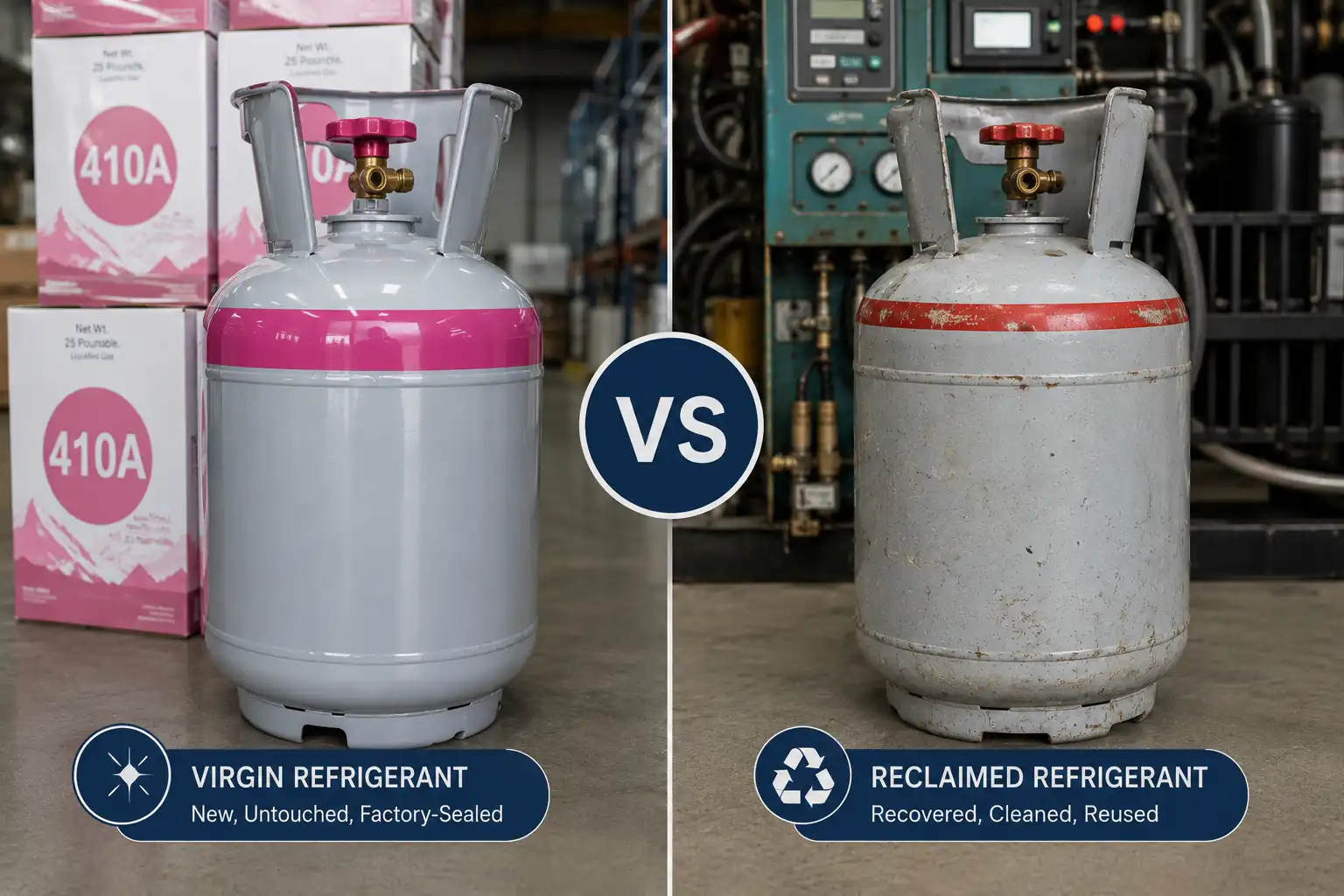
Quick answer: Virgin refrigerant is newly manufactured and has never been used in a system. Reclaimed refrigerant has been recovered from an existing system, processed by an EPA-certified reclaimer, and tested to the same AHRI Standard 700 purity specification that applies to virgin product. When reclamation is done correctly, the two are chemically indistinguishable in the cylinder. The real differences are legal (some refrigerants can only be sold as reclaimed) and practical (sourcing, batch consistency, and price).
Ask ten contractors what separates virgin refrigerant from reclaimed refrigerant and most will say something about quality, as if reclaimed is the discount option and virgin is the safe bet. That distinction made sense twenty years ago, before the EPA tightened reclaimer certification rules. It doesn’t hold up as well today, and understanding why matters for how you spend your refrigerant budget in 2026.
What the Terms Actually Mean
Virgin refrigerant comes straight from a manufacturer’s production line. It has never been charged into a system. This is the only category available for refrigerants still in active production, like R-454B and R-32.
Reclaimed refrigerant starts as used refrigerant recovered from a system by a certified technician, who has no intention of putting it back into the same equipment it came from. Under EPA’s regulatory definition, that recovery-with-no-return-intent is precisely what triggers the reclamation requirement in the first place. The recovered gas then goes to an EPA-certified reclaimer, where it’s filtered, dried, and often run through a distillation process to strip out oil residue, moisture, non-condensable gases, and any cross-contamination from other refrigerant types. Once processed, it’s tested against AHRI Standard 700, the same purity benchmark that applies to virgin product, before it can legally be sold and labeled as reclaimed.
There’s a third term people sometimes use loosely: repackaged. Repackaged refrigerant is virgin product transferred from a bulk container into smaller cylinders without ever being used in a system. It hasn’t been reclaimed because it was never dirty to begin with, but it also isn’t sold in the original manufacturer packaging. AHRI 700 covers repackaged product too, since purity has to be verified regardless of how it got into the cylinder someone is holding.
The Certification Chain Behind a Reclaimed Cylinder
The EPA doesn’t let just anyone call themselves a reclaimer. To get certified, a company has to submit documentation proving several things at once. Recovery equipment used to pull refrigerant out of a system in the first place has to be certified by AHRI or UL. Every batch has to be verified for purity using AHRI 700 test methods, either in-house or through a contracted lab, and if that lab gets the testing wrong, liability still falls on the reclaimer, not the lab. Reclaimers also have to certify that no more than 1.5 percent of the refrigerant is lost or released during the reclamation process itself, and they’re on the hook for proper disposal of whatever contaminants get filtered out.
The full checklist EPA uses to evaluate a reclaimer application is public, and it’s worth reading if you’ve ever wondered why reclaimed refrigerant from an established reclaimer costs what it does. Processing refrigerant to spec, tracking every batch, and maintaining certified equipment is not a cheap operation to run. You can review the requirements directly on EPA’s reclaimer certification checklist page.
Virgin vs. Reclaimed: Side by Side
| Factor | Virgin | Reclaimed |
|---|---|---|
| Source | Manufactured new, never charged into a system | Recovered from existing equipment, then processed |
| Purity standard | AHRI Standard 700 | AHRI Standard 700 (same specification) |
| Availability | Only refrigerants still in active production | Any refrigerant with enough recoverable installed base |
| R-22 | Not available. Virgin production and import ended January 1, 2020. | Only legal supply source besides pre-2020 stockpiles |
| R-410A | Available, but under AIM Act production caps | Growing share as more installed systems age out |
| R-454B / R-32 | Standard supply, given how recently these entered the market | Minimal supply today, will increase over the next decade as installed base grows and ages |
| Typical price position | Sets the market baseline for actively produced refrigerants | For discontinued refrigerants like R-22, price is driven by shrinking supply, not by any quality discount |
| Buyer certification required | EPA Section 608 (HVAC) or 609 (automotive) | Same requirement, no exception for reclaimed product |
Why Reclaimed Refrigerant Has a Reputation Problem It Doesn’t Fully Deserve
The skepticism around reclaimed refrigerant isn’t baseless, it’s just outdated. Before the EPA tightened enforcement and expanded reclaimer certification requirements, there was more room for recovered refrigerant to circulate without proper processing. Some of that history is still floating around as industry folklore, told by techs who had one bad batch fifteen years ago and never touched reclaimed product again.
The current system closes most of that gap. A cylinder labeled as AHRI 700-compliant reclaimed refrigerant has gone through the same purity test methods as virgin product, verified by the reclaimer or an independent lab under EPA oversight. The composition, moisture content, acidity, non-condensable gas level, and high-boiling residue all have to fall within the same limits regardless of where the refrigerant originally came from. That’s the point of AHRI 700 covering “regardless of source” in its own scope language: the standard doesn’t grade reclaimed product on a curve.
Where problems still happen is with refrigerant that skips this process entirely, recovered gas sold or reused without reclamation, sometimes mislabeled, sometimes mixed with other refrigerant types in the same cylinder. That’s not reclaimed refrigerant behaving badly. That’s refrigerant that was never actually reclaimed, being passed off as if it were. The distinction matters, and it’s the reason documentation and reclaimer identification on the cylinder are worth checking before you buy from an unfamiliar source.
How Little of the Market Is Actually Reclaimed
Here’s a number that surprises most contractors: in 2020, only about 1.6 percent of the HFC refrigerant sold in the United States was reclaimed product ready for reuse. Almost everything moving through the supply chain was virgin. That’s changed somewhat as the AIM Act phasedown has squeezed virgin HFC production, but reclaimed HFC volume still trails virgin volume by a wide margin, and industry sources at reclamation companies like Hudson Technologies have noted that even R-410A, which has been in service long enough to build a large installed base, is only being reclaimed at roughly a quarter of the rate R-22 hit at its peak.
Share of HFC refrigerant sold in the U.S. that was reclaimed (2020)
Source: U.S. EPA data, cited in ACHR News, “EPA Sees Uptick in HFC Reclamation,” October 2024.
R-22 tells a different story, because there’s been nowhere else for the supply to come from since 2020. Between 2000 and 2018 alone, EPA-certified reclaimers reported processing more than 140 million pounds of HCFC-22. That’s not a niche supply chain. It’s the primary reason millions of pre-2010 R-22 systems are still serviceable today, seven years after new production stopped entirely.
What to Check Before You Buy Reclaimed Refrigerant
- Ask which reclaimer processed it. A legitimate cylinder should be traceable to a named, EPA-certified reclaiming company, not a vague “processed to industry standard” claim with no company attached.
- Ask for AHRI 700 test documentation. A supplier working with a real reclaimer can produce or reference batch test results. If nobody can answer where the purity verification came from, treat that as a warning sign.
- Confirm your own EPA certification is on file. This applies to virgin and reclaimed product equally. Containers larger than two pounds cannot legally be sold to a buyer without Section 608 or 609 credentials, and a supplier who doesn’t ask for yours isn’t following the rule either.
- Check the cylinder condition, not just the paperwork. A properly reclaimed and repackaged cylinder should arrive sealed, with no signs of prior tampering or reuse of a damaged valve.
- Understand what you’re buying it for. Reclaimed R-22 for servicing a legacy system is a completely different purchase decision than reclaimed R-410A for a system still well within its supported service life, where virgin product is usually the more straightforward option simply because it’s more available.
The Financial Side Nobody Talks About
There’s an angle to reclamation that has nothing to do with buying refrigerant and everything to do with recovering it. Under EPA rules, venting refrigerant instead of recovering it isn’t just against the rules, it carries civil penalties that can run up to tens of thousands of dollars per day for a violation. On the other side of that same rule, a contractor or scrap operation that properly recovers refrigerant from decommissioned equipment can sell that recovered gas to a certified reclaimer for real money. A residential system holding a 6-pound R-22 charge, for example, can generate somewhere in the range of $18 to $42 in recovered refrigerant value alone, on top of whatever the scrap metal itself is worth. It’s a detail worth mentioning to customers who assume an old R-22 unit being torn out is pure cost with nothing coming back.
Frequently Asked Questions
Is reclaimed refrigerant lower quality than virgin refrigerant?
Not when it’s properly reclaimed. Both are held to the same AHRI Standard 700 purity specification, and EPA-certified reclaimers are required to verify every batch against that standard before it can be sold. The quality gap people remember from decades ago has narrowed significantly since EPA tightened reclaimer certification requirements.
Can I buy virgin R-22?
No. Virgin R-22 production and import ended in the United States on January 1, 2020. Reclaimed R-22, along with pre-2020 stockpiles, is the only legal supply remaining for servicing existing R-22 systems.
Do I need EPA certification to buy reclaimed refrigerant?
Yes. The Section 608 or 609 certification requirement applies equally to virgin and reclaimed refrigerant. Refrigerant sold in containers over two pounds cannot legally go to a buyer without the appropriate certification on file.
How do I know if reclaimed refrigerant was actually processed correctly?
Ask which EPA-certified reclaimer processed the batch and whether AHRI 700 test documentation is available. A legitimate supplier should be able to name the reclaimer and speak to how purity was verified, not just describe the product as “cleaned” or “processed.”
Is reclaimed refrigerant cheaper than virgin?
It depends entirely on the refrigerant. For actively produced refrigerants like R-410A, virgin typically sets the market price and reclaimed can be competitive depending on supply. For discontinued refrigerants like R-22, reclaimed is often priced at a premium relative to historical rates, driven by shrinking supply rather than any difference in quality.
Where This Fits When You’re Buying
The honest way to think about virgin versus reclaimed isn’t better versus worse. It’s available versus not available, and legal versus not legal, depending on which refrigerant you need. To R-22, reclaimed is the only road left. For R-410A, both exist side by side, and either one meeting AHRI 700 gets the job done. And for R-454B and R-32, virgin is essentially the only option right now simply because the installed base is too new to be generating meaningful recovery volume yet, though that will shift over the next decade as more of these systems reach end of life.
What matters more than the virgin-or-reclaimed label is who processed it and whether that process is documented. Every cylinder we ship, virgin or reclaimed, is AHRI 700 tested and comes from certified sourcing, with no repackaged or undocumented product mixed into inventory.
Sources:
- U.S. EPA, Checklist for Refrigerant Reclaimers Seeking EPA Certification
- U.S. EPA, Homeowners and Consumers Frequently Asked Questions (HCFC-22 reclamation totals)
- AHRI Standard 700, Specifications for Refrigerants
- ACHR News, “EPA Sees Uptick in HFC Reclamation,” October 2024
- ACHR News, “Low Recovery Rates Threaten Future Refrigerant Supplies”